Posts

Benthic brotherhood: part 2

This story begins in Qingdao. I was sitting around a round table, having lunch at the Ocean University of China. The university dining services were apparently busy that day, because our group was combined with another group for lunch. A short woman in a blue shirt introduced herself to Ji and me. "Aren't you the one who wrote that modeling paper about fish genetics?" Ji asked. "I feel like I've seen you give a seminar before." The woman nodded and confirmed she had written the paper. She explained more about her research to Ji while we all found our places at the table, and I listened intently. Once she had finished, she turned to me. I introduced myself as a benthic ecologist postdoc from WHOI. She said she was from the National University of Taiwan. "Taiwan?" I leaned in. "Perhaps you know my friend, Stefanie. I'm going to Taipei to see her tomorrow." The woman did know Stefanie, and over the next hour, we discovered we had...

World religion day

Image
" Let the words of my mouth, and the meditation of my heart, be acceptable in thy sight, O LORD, my strength, and my redeemer." - Psalm 19:14 Walking slowly with the crowd, I exited the lobby and stepped out into the rain. It was Sunday morning, and I was leaving church. I felt refreshed, renewed, and calm.  I wasn't sure what to expect from Taiwanese worship, but  I always enjoy experiencing different churches when I'm abroad.  This one called itself Lutheran, but it really had the makings of an American non-denominational mega-church. The service was held in a large room on the second floor of a skyscraper in downtown Taipei. There was a balcony for expanded seating and LED screens at the front to shown song lyrics and visual aids. The service format was also simplified, containing only music, announcements, prayers, and a sermon. Instead of a traditional organ, the songs were accompanied by drums, keyboard, and guitar.  Most of the song lyrics were tr...

Misty city

Image
Friends, I've said it before, and I'll say it again: it is the people I meet who make my mobile life worthwhile. After leaving Qingdao, I flew to Taipei, Taiwan, where I got to spend time with my dear friend, Stefanie. I'm not sure if you remember, but Stefanie and I met when I lived in Germany in 2011 - 2012. She's also a scientist with a travel habit, so we usually manage to be on the same continent about once a year. I've told you about visits with her before, in Boston , Hawaii , and the Netherlands . To be honest, I find it incredible that we manage to see each other as often as we do, since we're both moving targets. Stefanie is supportive and trustworthy, and I value her friendship greatly. Overview of Taipei from the gondola at the zoo We started with a city tour Taipei, and I have to unfortunately admit that it's not my favorite city. The air pollution hangs in the humid air like a mist, making any long-range view of the city shrouded in dirt...

Grand tour

Image
Before we left on our trip, Ji referred to Qingdao as "the Woods Hole of China." Woods Hole, Massachusetts has a number of private and federal research institutions, so it's a destination for ocean sciences. The village population is also disproportionately dominated by researchers. Qingdao is very much the same. Of course, the comparison meant I was picturing a small town and was surprised to find a city of 9 million people when I arrived in Qingdao, but the analogy stands. Qingdao has five large research institutions and plenty of researchers to go around. We took advantage of our time in Qingdao by touching base with each of the research institutions in the city. And let me tell you, we got quite the grand tour. We spent one afternoon at the First Institute of Oceanography, where I got to tour the institute's deep-sea geological collection. Rocks and mineral deposits from all over the deep sea, particularly hydrothermal vents, were housed in cases and displayed...

Parallel universe

Image
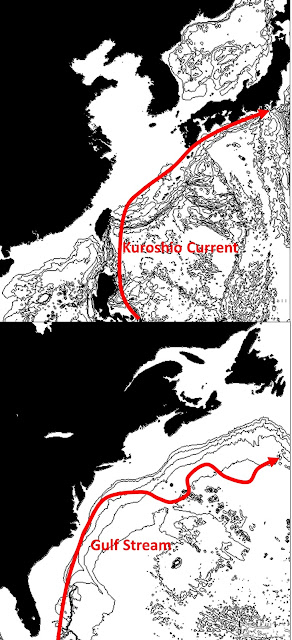
Leaning forward in my black leather chair, I grabbed my mug and took a sip of my green tea. The tea leaves were floating loose in the water, unencumbered by a mesh strainer. The hot water felt good on my throat. It was early morning, and I was in yet another conference room, this time back at OUC. Another WHOI scientist who was unable to travel with us video-conferenced into the meeting, and I listened to his voice rining out from Ji's laptop. One by one, his slides changed on the projector screen. I hugged my tea mug with my hands and leaned back onto the chair. I was relaxed. The meeting was for another WHOI-OUC project, and a large part of the discussion actually focused on similarities between Chinese and American oceanography. Think about this: both China and the U.S. have long eastern coasts that span sub-tropical and temperate latitudes. The east coast of China and the east coast of the U.S. both have a broad continental shelf and a strong current system - the Gulf Stream ...

Benthic brotherhood

I was full from a delicious and adventurous lunch, and once again, I found myself following Ji into a conference room. This meeting used the same general format - researchers briefly presenting their work, followed by an open discussion - except this time, everyone spoke my language. Not Mandarin (I can still only say "hello" and "thank you") - they spoke Benthos. There's a benthic research group at the Institute of Oceanology of the Chinese Academy of Sciences in Qingdao, and I felt right at home with them. We spent a whole afternoon discussing our work.  I deeply enjoyed speaking with the IOCAS group because we have so many research interests in common. They specialize in macrobenthos - animals that live in the seafloor and are big enough to see with the naked eye - just like me. They work on ecology (ooh) and taxonomy (aah) of animals in the Chinese marginal seas. They have this amazing collection of samples from all over the Yellow Sea shelf and even the...

Qingdao in pictures

Image
Downtown waterfront This hilltop Buddhist temple is in Qingdao's "Old Town." This beach is directly across the street from the Institute of Oceanology of the Chinese Academy of Sciences. Small motorcycles are common, and riders use custom-cut blankets to shield themselves from road spray. The coastal mountain range, seen from the First Institute of Oceanography campus Translation fail. I think they're trying to say "Don't overfill your plate and then end up wasting food." Seen from the First Institute of Oceanography pier