Posts

The Stellwagen paper: part 2
Image
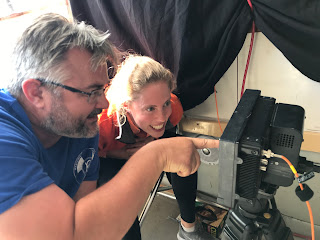
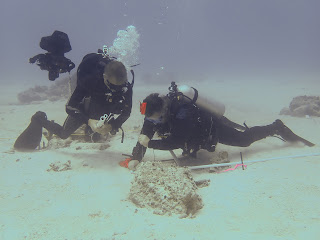
Friends, I am proud to announce yet another paper resulting from my research has been published. This one is actually a great source of pride for me, because it represents the culmination of all the research my team undertook in Stellwagen Bank National Marine Sanctuary in 2019-2020.  We used remotely operated vehicles to survey four shipwrecks: the steamship Portland , an unidentified 19th century coal schooner, and the interlocked coal schooners Frank A. Palmer and Louise B. Crary . The project launched Team Shipwreck and exposed me to the power of telepresence outreach.  Calvin and me on board R/V Dawn Treader during 2019 field operations. This photo is entirely candid, but my excitement is palpable. Photo by Liz Weinberg (NOAA). What I'm most proud of is the framework that my team developed for shipwreck research. Every time we went out to sea, Calvin and I would sit right next to each other. At first, our conversations were essentially in parallel - he would notice some...
Rising tide

It is a quiet Friday afternoon in Woods Hole, and I am alone in my office. My back is sore from standing at the lab bench, and I can still feel the raw spots on my fingers from orchestra rehearsal last night. It's sunny outside. Life is good.  Science is such a weird career. It's truly boom and bust. Sometimes, I have to frantically prepare for a field trip, scramble to get paperwork together, and crank through sample analysis. Other times, I sit and think about abstract concepts and unanswered questions. It seems there's little in between.  Recently, my lab has felt like a well-oiled machine. We've had two papers published recently*. The field team I sent to Saipan had a successful mission . My grad student's thesis outline is coming along nicely, and our samples from Palau have yielded nice preliminary data. I even managed to submit a proposal this week.  Is this what leadership is supposed to feel like? I sure hope so, because it's marvelous. Samples are be...

Sitrep

Image
Every morning this week, I have eagerly opened my email and scanned the messages for one word: "Sitrep." It's a short-hand for "situation report" that is typically used in military operations. And it's what I'm living for right now.  Calvin and Evan collecting samples in Saipan. Photo by Jen McKinnon. Some of you may recall that I sent a team into the field recently. I never told you what the project was about, but now that the operation is underway, I have the freedom to share a bit more detail. The field team is in Saipan, and they're trying to find out whether environmental DNA (eDNA) could be used to locate human remains at underwater sites left by past U.S. conflicts. In this particular case, they're looking at three airplanes from WWII.  This project is different from anything I've ever done before, and it's my first time working with the DPAA (Defense POW/MIA Accounting Agency). My lab was approached initially because we are one o...

The Stellwagen paper

Image
It is always a good day when my work culminates in a publication! This week, the latest paper from my lab was released in the journal Marine Ecology Progress Series . You can read it here .  Back in 2019-2020, I led an interdisciplinary team on an investigation of shipwrecks in Stellwagen Bank National Marine Sanctuary. Some of you might remember that project - it had a huge outreach component, with telepresence broadcasts so anyone could follow along as we explored. I loved the telepresence! It was a blast to speak live with our audiences, especially students, and answer their questions about shipwrecks.  After the field work ended, I still had a lot of work ahead of me. I spent hours reviewing the footage we had collected to make sense of how shipwrecks function as habitats. When covid hit , I let my ambition run wild - while stuck at home, I added old recordings to my analysis, until I had personally watched every single video recorded from a shipwreck in SBNMS since it ...

Mystery sponge

Image
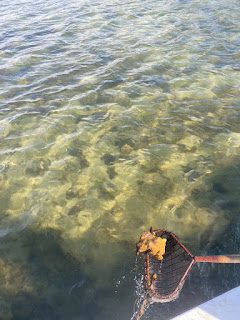
Collection of the sponge in Mashpee, MA A few weeks ago, I got an email from a Natural Resource Officer in the neighboring town, Mashpee, with a request for assistance identifying a marine sponge. Messages like this show up every once in a while.  When you work at "The Oceanographic" (as many people in town call it), the local community rightly assumes they can come to you for expertise. I love helping out. For all of the times in my career that I've had to ask others for help identifying species , I take great pleasure in helping others with their specimens.  Identifying species is always easier if you have a physical specimen , so that was my first question for the officer: " Do you have a sample ?" Two days later, a sponge appeared in my lab refrigerator.  My first step was a dissection. Sponges have skeletal elements called spicules. They're small pieces of silica or calcium carbonate that help the sponge hold its shape, and they're absolutely es...

The life of the pre-tenured faculty: part 2

Image
This electrophoresis gel shows are samples are good to go! Photo by Alexa Huzar.  An email showed up in my inbox with a photo attached. I could recognize immediately what it was - an electrophoresis gel . There were some bright bands on it, some smears, and a DNA ladder. All very standard stuff. Whoever had made the gel obviously knew what they were doing, and those bright bands indicated they had high-quality samples.  The email that accompanied the image told a similarly optimistic story. The samples were ready to go and should be delivered to the sequencing facility within a few days.  I leaned back from my computer and shrugged. My research project just took a large step forward, and I didn't have to do anything for it. One of the other team members was on the job, and all I had to do was wait . Sweet! One of the hardest adjustments for me as faculty is realizing that I don't have to do everything myself. I can organize; I can lead ; I can still be hands-on, but I do...

The life of the pre-tenured faculty

Image
I knew going into my academic career that things were going to be hectic. There is a common understanding that life as an pre-tenured faculty is especially crazy - just check out my favorite  comic strip . It is entirely  too accurate . Yes, starting a lab, securing funding, mentoring students, and proving your worthiness for tenure can stress a lot of people out. I won't pretend like I'm immune. But like all things, faculty life also has its silver lining. I for one thoroughly enjoy that I now have the opportunity to mentor my own students. The first-ever Meyer-Kaiser lab PhD student started last year, and it has been my utmost pleasure to work with her since.  We hit an especially high point last week. Now that my student, Kharis, is in her second year of the program, her main occupation is planning her dissertation. (Of course, she's also done other things, like accompany me to Palau .) Planning a dissertation is hard. Planning any research is hard, but for most people...