Posts

On the way down

Image
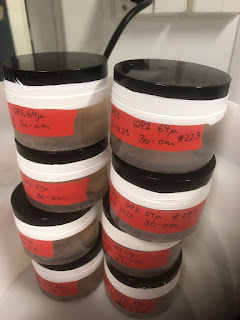
Kharis happily packing our things. I stood in the middle of the lounge area on the upper floor of the marine lab, hands on hips, not looking at anything in particular. Just thinking. What was my next move? We had finished all our scientific work. Over 500 larvae rested safely in small jars of ethanol; we had 32 jars of sediment and all the animals in it preserved in formalin; CATAIN was on the seafloor; and Kharis was busily packing up our gear downstairs. What was I to do?  So I made a cup of tea and sipped it on the couch.  My grad student, Kharis, is a bit unusual among scientists: she actually enjoys the logistics that accompany field work. Anytime we travel together, she sets up the lab, catalogs the samples, breaks down the equipment, and packs everything to go home. I try to help, but she really doesn't need me. It's a pretty convenient trait for an apprentice to have - when she handles the logistics, it frees me up to work on big-picture things. Or, you know, tak...

Isotopes

Image
We figured out that larvae in the polar night are not quiescent - they are active. When you give them food, they eat it. They're even capable of metamorphosing and settling . Incredible. When Kharis and I tested whether the larvae could feed, we gave them phytoplankton because we knew it was something they would eat. But there's no phytoplankton in the polar night. It's pitch black outside. We know that larvae did eat phytoplankton in our lab test, but they can't be eating phytoplankton out in the fjord. What are they eating instead? We ran an experiment to try and figure that out. I had two hypotheses: maybe the larvae are eating bacteria, and maybe the larvae are eating dissolved organic matter. There have been studies from other parts of the world showing that larvae can use both bacteria and dissolved organic matter as food sources, but as far as I know, nobody's tested them in the polar night.  To test my hypotheses, I turned to isotopes. You might remember ...

Quiescence

Image
Bivalve veligers (baby clams). The top individual was starved, and the  bottom individual was fed for 48 hr. Photos by Kharis Schrage. Friends, your vocabulary word for the day is "quiescence." It refers to a state of inactivity or dormancy. There are actually several types of dormancy in biology, each with their own physiological definition. Quiescence occurs during unfavorable environmental conditions, and an animal can resume activity after the environmental conditions improve.  So are larvae in the polar night quiescent? I wouldn't blame them if they were. I mean, it's pitch black outside, and there's no food. Why not just go dormant until the spring bloom?  One of the main goals Kharis and I had for this trip is to figure out whether larvae in the polar night are quiescent, patiently waiting until the sun comes back and there's food available. Quiescent larvae wouldn't do much - just kind of drift around. They wouldn't eat, and they certainly woul...

Northernmost community

Image
Everywhere around Ny-Ă…lesund, you will see the phrase "the world's northernmost community." It's true - the research station is the closest you can possibly live to the North Pole year-round. There are some temporary ice camps, and of course ships travel into the central Arctic, but as far as permanent settlements go, Ny-Ă…lesund is the farthest north.  You could call  Ny-Ă…lesund the world's northernmost town, settlement, or research station - all of those descriptors would be accurate. But I find "community" to be the most appropriate. Because up here, there's a very strong sense that we rely on one another.  When you go into the mess hall for meals, you sit at whatever table has available seats. If you don't know the person across from you, you introduce yourself. That's happened to me many times. In one case, I struck up a conversation with an Italian researcher who was passionate about invertebrates. She told me about a project she had don...

Dark Knight: part 2

Image
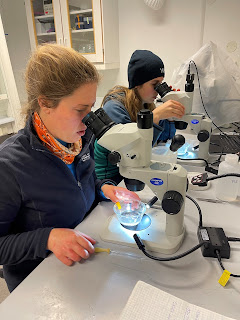
Sorting plankton with Kharis. Photo by Alexa Elliott, Changing Seas/South Florida PBS. Kharis and I sat shoulder to shoulder at the microscopes in our lab. Out of the corner of my eye, I could see her pipet moving back and forth between the dish under her scope and the collection well next to her every few seconds. Back and forth, back and forth - she must have a lot of larvae in her dish. I had plenty myself, actually. One by one, I picked tiny clam after tiny clam from my dish. My eyes wandered to the remainder of the sample, sitting in a tall beaker on the bench between us. It was mostly full. Over a liter and a half to go. How were we ever going to get through it?  When it rains, it pours, right? Larvae are super patchy, so you can catch almost nothing for days on end and then be swarmed with the little buggers. If you just dip your net in the right place in the ocean at the right time, you can end up with more larvae than you ever wanted. That's what happened to us.  We h...

Polar night research in photos: part 2

Image
There's a green laser on one of the research buildings that's used to make measurements of different parameters in the atmosphere. It shoots straight up and can be seen from anywhere in town. Photo by Kharis Schrage. Aurora borealis! Photo by Kharis Schrage. This photo was taken with a long exposure, so it's actually lighter than what you see in life. Nevertheless, it's a nice view of the harbor and out across the fjord. Photo by Kharis Schrage. We found this cool scale worm on the dock! Photo by Kharis Schrage. This embryo is pretty big and looks exactly like some that I found in 2020. Photo by Kharis Schrage. This little worm is one of our most common species. So cute! Photo by Kharis Schrage. This embryo is interesting because it looks like a donut. Photo by Kharis Schrage. This little snail larvae is super common. Photo by Kharis Schrage.  This larva will grow up to be an anemone that lives in a tube. Photo by Kharis Schrage. 

Changing Seas

Image
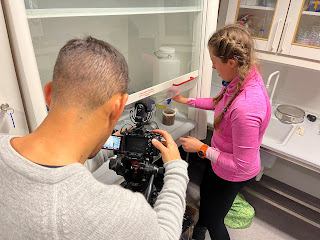
Every field trip is different. My career so far has included all sorts of field work - 6 weeks on a global-class ship in international waters, short day-trips in state waters , stints at land-based field stations , SCUBA trips , tidepooling , and pretty much everything in between. Each time, I get to know a new team , try new techniques , and flex my skills as a leader . No two field trips are the same. And this one is different from all of them. Sure, I've been to Ny- Ă…lesund twice before. I've worked in the Arctic  for over 10 years, including during the polar night . I've traveled with my PhD student, Kharis , twice already and am very familiar with her working style. So what makes this trip different? Well, we have a film crew. David Diez films me preserving a sediment sample. Photo by Alexa Elliott, Changing Seas/South Florida PBS. That's right, Kharis and I have been shadowed by a producer and two videographers during part of our trip. They are from the South Flo...