Posts

By perseverance

Image
"By perseverance, the snail reached the Ark."  - Charles Spurgeon Leading a research lab is like trying to write a book in a tornado. Every day, I sit at my desk and put text on paper, hoping my words will compel a federal agency or a private foundation to grant us the money we need to keep going. Or I deal with finances, correspondence, and standardized forms - the hum-drum paperwork that for some reason the world requires. If I'm lucky, I get to write a paper reporting our scientific results.  Meanwhile, my lab is a flurry of activity. An incessant clicking from the far corner indicates my technician, Sarah, is busy counting zooplankton. My postdoc, Johanna, paces around the molecular biology bench as she extracts and amplifies DNA from tiny larvae. New boxes of samples showed up in the freezer last night, indicating my PhD student, Kharis, is finally home from her own whirlwind research trip in the high Arctic . Multiple times per day, someone sticks their head into ...

The nomination

Image
Friends, I have some very exciting news to share today. "Life in the dark: the polar night" has been nominated for a Suncoast Regional Emmy award!  In January 2023, my grad student, Kharis, and I were joined in the field by a film crew from South Florida PBS. The producer, Alexa Elliott, wanted to share the story of our high Arctic research as part of the series Changing Seas . Our episode premiered on TV and online in June. You can watch it anytime on YouTube:  https://www.youtube.com/watch?v=rAS0osFsneI It is incredibly exciting for an episode featuring my lab's research to be nominated for this award. If you check the list of nominees, you'll notice that another Changing Seas episode was also nominated! Alexa and her production team do incredible work, and I am glad to see them receive much-deserved recognition.  The Suncoast Regional Emmy Awards event is on December 2. It is an honor to be nominated, but I also hope the Changing Seas team walks away with at lea...

Name that fungus!

Image
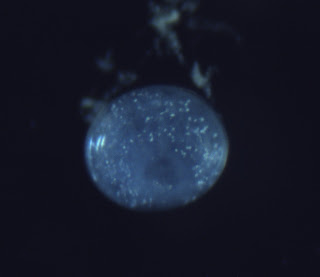
The mysterious specimen Back in 2021, Kharis and I took a deep-sea plankton pump to the Arctic. The pump was installed on a lander by my German collaborators at the Alfred Wegener Institute and sent down to the deep. From 2.5 km away, Kharis and I wished and hoped for good samples, sending good vibes to the pump whenever we could. We got some incredible specimens .  Of all the beautiful larvae we collected that trip, one stood out to me. I pulled it from the watery sample, not knowing what it was. It kind of resembled an egg. Maybe it was an elusive deep-sea larva, I thought, but I wasn't sure what kind. We found 20 of them - sparkly blue orbs with gold flecks. A few of them were housed inside a loose mesh of spikes. My invertebrate-seeking mind concluded that the spikes must be sponge spicules, and we had found the first sponge larvae from the Arctic deep sea. You can imagine my excitement when, months later, Kharis got a successful sequence from one of the mystery orbs. Here w...

Magellan

Image
"The sea is dangerous and its storms terrible, but these obstacles have never been sufficient reason to remain ashore."  - Ferdinand Magellan In grad school, one of my friends used to say that he was a professional reader. At the time, he was working on a review paper that would constitute the introduction to his thesis, so he wasn't entirely wrong. I think he read a few hundred papers that year. He had to be deeply familiar with his field in order to craft the review.  Atlantic sea scallop, Placopecten magellanicus . Can you see the growth rings? Science involves not just the search for knowledge but a familiarity with all previous knowledge. Right now, I find myself in a phase that could very well be described as "professional reading." I've read some 50 papers about sea scallops in the last week. My eyes are getting tired.  Why am I busy ingesting scallop facts, you ask? There's a good reason, trust me. One of my colleagues at WHOI recently invited me...

Name that zoea!

Image
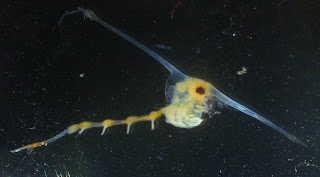
Friends, it has been a productive few weeks over in my corner of the world. I'm busy at the microscope, sorting and identifying zooplankton from the Gulf of Mexico. This zoea larva came from one of my plankton samples. Check out that spike! Long spines and spikes help protect plankton from predators.  Last summer, I was part of a team investigating shipwrecks and natural hard-bottom reefs in the mesophotic zone, between 50 and 200 m deep. Recently, I've waded my way through all the ROV video we collected and found magnificent species of fish and corals along the way. The next step is to analyze plankton samples  I collected when we were at sea.  I wasn't quite sure what would be in the plankton samples or what they would show. I've been curious for a while about how animals disperse to shipwrecks as larvae, so I thought that plankton samples collected from the water column right above shipwrecks might offer some clues.  Take a guess: Am I finding larvae of the c...

Name that coral!

Image
I am back at it - analyzing all the video footage my team collected from the Gulf of Mexico last summer. I finished the fish already , so now I feel more at home: I am identifying the invertebrates .  This frame grab from our mystery shipwreck  shows cup corals ( Tubastrea coccinea ) and sea rods ( Diodogorgia nodulifera ) . Many of the engineers at WHOI subscribe to a 3-part taxonomic system. Having little knowledge of the living creatures in the wide, watery world, the engineers classify objects they observe in the ocean into three categories. An object is either a rock, a shark, or snot. That's right - all inanimate objects are termed "rocks," all swimming animals are called "sharks," and the rest gets described as "snot." I didn't say it was a good system, mind you.  I suppose under the rock-shark-snot worldview, all the sessile invertebrates that I love so much fall into the "snot" category. To be fair, they are a bit slimy someti...

CATAIN lives!

Image
It's always a good day when I open my email to a message from the field . Kharis is in Svalbard right now, so I've been watching my email for updates. She's sent me periodic communications about sample collection, sorting larvae, and life at the research station. Aside from the normal ups-and-downs of field work, everything is going pretty well. Except for one thing: CATAIN.  CATAIN being lifted out of the fjord by R/V  Teisten . Photo by Kharis Schrage. We deployed CATAIN on the seafloor in Kongsfjorden last January, and Kharis was tasked with recovering it this trip. She learned how t o operate our lab's ROV  for the recovery operation. She flew all the way up to Ny-Ă…lesund, Svalbard. She went out on the Kings Bay research boat, Teis ten . And...no dice. Kongsfjorden is very different in the summer compared to the winter. In the winter, the water is crystal clear, even if it is dark out all day. In the summer, though, the glaciers release turbid water into the f...