Posts

Tessellation

Image
Man, it was a fun day it the lab yesterday. Kharis, Sarah, and I spent the whole morning working on a project together, and we managed to make great progress.  Recently, Kharis has been struggling to identify larvae from the Arctic. Don't get me wrong - we have a good methodology , thanks to a few years of struggling and about 6 months of Johanna troubleshooting. We can reliably get good-quality sequences from our specimens now. The DNA was not the problem (for once). Kharis's struggle has been morphology. She sorted all her larvae into categories based on how they looked in the field. It's a strategy I taught her - sort everything live, photograph and preserve the specimens, then sequence them back in the lab. By sorting up-front, you can save yourself a lot of time and just sequence a few representatives of each morphotype once you're home. If the sequences for those representatives line up, you have a reliable identification for the morphotype.  If.  See, that'...

The interns

Image
Hollis joined the lab through his school's  mentorship program.  Friends, I want to tell you about something magical that's happening in our lab right now. As you know, I am passionate about mentoring the next generation of scientists. It's why I've taken on a PhD student, a postdoc, and two summer undergraduates at WHOI. If my lab was at a standard university with all sorts of students running around, I would be the professor who proudly offered research opportunities to anyone who wanted the experience. Woods Hole is decidedly short on undergrads, but what we do have are high school students hungry for a chance.  One student is doing his science fair project under my lab's mentorship for the second year in a row. Two students who did internships with us last year asked if they could come back to keep learning. I also recently signed up for the mentorship program through a high school on Martha's Vineyard and got a fantastic new lab member . Just this week, tw...

Textile art

Image
Johanna's photo: high-tech crafting When I arrived at work this morning, my postdoc, Johanna, pulled up a photo on her phone to show me. Proudly, she held the screen up to my face and then started giggling. The photo was taken in WHOI's AVAST facility - a high-tech work space on WHOI's campus. AVAST stands for Autonomous Vehicles And Sensor Technologies, but the facility is meant to be a collaboration hub for all kinds of research and technology development. It's a very 21st-century, open-concept, community-use work space outfitted with 3D printers and test tanks. The high ceiling and garage-style doors let robotic undersea vehicles come in and out. There are several vehicles being worked on at AVAST right now - a mid-water vehicle that follows fishes and collects their DNA, a full-ocean-depth vehicle with sensors that can handle the pressure at 11,000 m deep, even a titanium sphere that I think belongs to the submersible Alvin . AVAST is by every measure a technologica...

In the cracks

Image
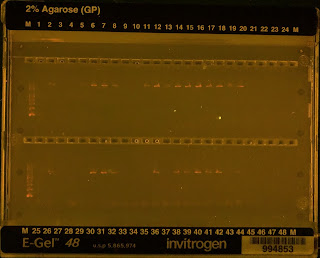
"There is a crack in everything That's how the light gets in" - "Anthem" by Leonard Cohen Friends, we are approaching the end of a calendar year, and I find myself feeling pressed. In many ways, the change of a calendar year is arbitrary, but I definitely have some projects that I don't want to carry over into another annum. The Porites spawning paper has finally been submitted. The zooplankton samples Sarah had been working on are done . Yet, I find myself spinning around, looking for something else I can accomplish before the year ends. I have to fill in the cracks between major projects with minor victories.  This electrophoresis gel shows my minor victory. On the left  side is a DNA ladder. Every band across the middle of the  gel represents a successful a DNA section that I will be able  to sequence. As you can see, I was very successful! Yesterday, I had a minor victory. In this gap between large datasets, I turned my attention to some mysterious A...

And the Emmy goes to...

Friends, you might remember that the episode of Changing Seas that Kharis and I were featured in was nominated for a Suncoast Regional Emmy . The award ceremony took place this past weekend, and I'm proud to announce that our episode won! I am incredibly proud of our PBS partners and honored to be part of their award-winning work. You can watch Alexa Elliott and Jacquelyn Hurtado accept the award below.  If you haven't seen "Life in the dark: the polar night," check it out here:  https://www.youtube.com/watch?v=rAS0osFsneI

Milestone passed!

Image
Friends, we had an exciting day in the lab this week. After 3 months of solid work, sorting animals day in and day out, and countless hours sitting at a microscope, Sarah finished a dataset!  Sarah and I tracked her progress on the white  board, and we were both clearly excited to  update it when all sorting was finished! Photo by Johanna Weston.  You might remember that my lab is collaborating on a study with the Palau International Coral Reef Center. Our goal is characterize the biodiversity of zooplankton in Palau National Marine Sanctuary. PICRC staff collected net tow samples in 2022, I brought them to WHOI last spring, and poor Sarah has been analyzing them ever since.  There are so many species. Seriously. So. Many. Species. It's kind of funny that there's another zooplankton project happening in the lab at the same time - Kharis is working on a set of samples from the high Arctic. It feels a bit like we've undertaken a case study in latitudinal clines ...

New kid on the block

Image
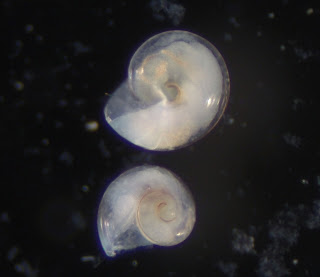
"I'm a new kid on the block Though I may not be Johann Sebastian Bach" - "New Kid (on the Block)" by BNL Whenever a new person sits down at a microscope in the lab, it takes a few minutes for them to get oriented. They have to learn to adjust the eyepieces to fit the width of their face. They take a minute to find the focus knob, then scroll up and down until the specimen comes into clear view. It's a process.  Some pteropod larvae (baby snails) in the sample I showed H.  I have a new high schooler in the lab, H, thanks to a mentoring program at a local high school. The mentorship in my lab is the first time he's been exposed to tiny animals like larvae, but he's very eager to learn. I showed him how to use the microscope, adjust the eyepieces, change focus, and make himself comfortable. I stood back. "What do you see?" I asked. At this point in the process, the student usually mentions something about copepods. They won't know what the...