Posts

Coral taxonomy

Image
 If Maikani had a catchphrase, it would be "I gotchu." She says it all the time. Ask her to hand you something - "I gotchu." Ask her what time it is - "I gotchu." Assign her a task, and she listens carefully, then finishes with "I gotchu."   You can imagine my surprise when I finished explaining to Maikani my expectations for her coral project,  and she turned silently to her computer screen. No "I gotchu" at all. With one hand, she maneuvered the mouse to open a photo, and with the other hand, she flipped to a page in the ID book I had given her. She even had the Corals of the World website open before I could say anything. It was like she had gone into auto-pilot. She knew exactly what she was doing.  Maikani knows corals not just because of her previous research experience. Corals are part of her identity. You see, she grew up in Palau, an island nation in the tropical Pacific that has become a world leader in ocean conservation. I...

Palau paper number one

Image
This morning, I received a text from my collaborator and former postdoc, Hanny: "IT IS OUT!!!!" The "it" in her exclamation needed no explanation. Neither did the ambiguous adjective "out." She was referring to the paper she had worked immensely hard on over the last several years. This paper is the first to report on our team's research in Palau, and I am immensely glad to see it in print.  The story of this paper is a story of scientific women. It actually starts with Anne Cohen, another scientist at WHOI, whose lab had been going to Palau for years. They noticed that corals in the semi-enclosed Rock Island lagoons in southern Palau had fewer stress bands than other corals. They bleached less often. This was completely counter-intuitive, because the lagoons are actually warmer than the surrounding reefs. What could be the explanation?  Hanny had an idea - she thought the genetics of those corals could possibly explain the differences in their bleachi...

Marquette

I awoke to the surprisingly loud sound of toddler feet pounding on the floor above my head. My nephew's high-pitched voice was exclaiming about something. The smell of coffee percolated down the stairs. From my basement guest room sanctuary, I could tell that the main floor of my sister's house was already chaotic - and it was only 7 am.  After delivering my seminar and exploring Alpena with my parents, I ventured up to Michigan's Upper Peninsula (also known as  the U.P. ). I went to college in the U.P., and two of my roommates and my sister are still there. I don't make it back to Marquette very often, but it's always a warm, uplifting trip when I do.  This particular trip had a theme: children. Between playing dinosaurs, attending a dance recital, and stopping for frozen yogurt in the middle of the winter, I talked about, held conversations with, and acted like a child the entire weekend long. That's life in your 30s.  There are so many stories I could tell. ...

Alpena

Image
"Nobody ends up in Alpena on accident." - Cassandra Sadler The first thing I knew about Alpena, Michigan was its location. When I was in high school, I would see the tiny point on weather maps on TV. It looked fairly isolated, just a name on the edge of a mitten-shaped peninsula, usually predicted to get hammered with snow.  I spent the first 21 years of my life in Michigan. Despite claiming once that I could drive anywhere in the state without having to look at a map , I somehow never passed through Alpena. It's a shame, really, because I missed out on an adorable little town and a hub for Maritime Heritage Ecology. Until now, that is.  I was invited to deliver a seminar on my research at the Great Lakes Maritime Heritage Center, headquarters of Thunder Bay National Marine Sanctuary in Alpena, Michigan. So I packed a bag, texted my mom, and flew to one of the tiniest little airports I've ever seen.  Presenting my seminar. Photo by Angela Meyer. Thunder Bay is an incr...

Genetics Unzipped

Recently, I was asked to participate in an episode of the Genetics Society's podcast, Genetics Unzipped. The interview focused primarily on my eDNA project ( you know , the one where we're trying to determine if environmental DNA could be an effective way to locate human remains from past wars). We also covered a little Maritime Heritage Ecology, too. I had a lot of fun with the podcast and encourage you to check out the episode here:  https://geneticsunzipped.com/blog/01/12/2022/bats-bodies-environmental-dna

Historiography

Image
Are you ready for your vocabulary word of the day? Historiography.  History, obviously, is the study of things that happened in the past.  Historiography, it turns out, is the study of how events were written down in the past - basically the history of history. It's also used in some academic journals to mean a summary of previous work on a subject.  These are the types of things you learn when you collaborate with an archaeologist .  Calvin and I are writing a paper right now that we're planning to submit to an archaeology journal, and we had to include a "historiography" section. This is a new experience for me. My papers usually appear in journals like Marine Ecology Progress Series , Limnology and Oceanography , Polar Biology , and Invertebrate Biology - all of which are specifically geared toward an audience of ecologists. You know, people who spend their days with animals, trying to figure out how they live and relate to their environment. People who don...

Wrecks of the semi-deep

Image
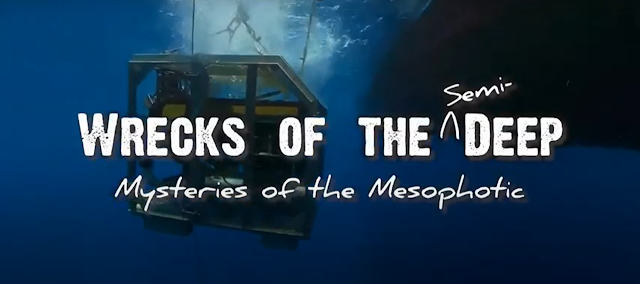
Friends, you might not realize this, but I have actually been working on another project while in Palau. Do you remember the expedition I went on in the Gulf of Mexico last June? That's right, the one where we investigated shipwrecks and natural hard-bottom habitats in the mesophotic zone. Well, the education component for that project happened to fall during November - while I was in Palau - so I undertook an extreme exercise in telepresence. Thanks to the internet, I could actually be in two places at once.  The team for the mesophotic project connected with classrooms across the US for conversations about our project, shipwrecks, and marine science in general. We had live viewers at middle schools and high schools across the Gulf Coast and the Northeast, but we also recorded everything on YouTube! If you're interested, you can check out our broadcasts at the links below.  Program 1:  https://www.youtube.com/watch?v=wciNw-TzsnY Program 2:  https://www.youtube.co...