Posts

The handoff

Science is a team sport. Imagine, if you will, a relay race. A pair of scientists start off the race in 2021. They run (or swim, if we're being literal) side-by-side while collecting corals in Palau. They collect a total of 4 species , spanning a range of families and growth forms. As they jog together on the track, one of them departs and the other continues alone, carrying all the samples in her arms. One by one, she crushes the coral samples to extract their DNA. This section of the track has several hurdles, so she jumps and glides and keeps crushing the corals, one by one.  And then, the runner rounds the bend, metaphorical baton in hand, and sees her teammate ahead. She finds fresh motivation and speeds up her pace, charging head-long toward the critical handoff. She passes the coral DNA to her teammate, who then continues along the track. That's right, friends, I finally handed off all the hundreds of corals I've been working on over the past several months. I have ...
The Portland in music

Image
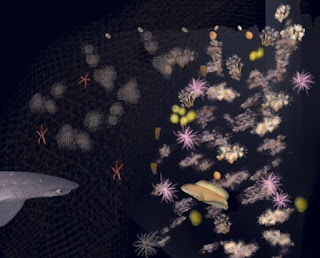
Friends, I want to share something actually really exciting with you. Recently, I've been collaborating with an organization called Sound Explorations to fuse science and art in a really unique way. Sound Explorations teaches science concepts through music. The idea is to make science accessible to people who don't relate to or can't access the traditional ways that science is presented (mostly visual), including people who are neurodivergent, blind, or visually impaired.  A screenshot from the video, showing some of the animals that colonize the shipwreck over time.  Sound Explorations' education director, Terry Wolkowicz, and their music director, David MacKenzie, got in contact with Calvin and me a little bit ago. They had already worked on a project with Stellwagen Bank National Marine Sanctuary and were looking to expand their content. Over the past few months, I've fielded emails from Terry about how organisms colonize shipwrecks. How do the animals move, wha...

Changing Seas: part 3

Image
It was immensely satisfying to watch the premiere of Changing Seas "Life in the dark: the polar night" on Wednesday. The South Florida PBS team did an amazing job editing all the footage they collected with us in the field and producing an informative show. I'm so glad this episode tells the story of our research to the world! In case you missed it, the episode is still on YouTube. You can watch it anytime:  https://www.youtube.com/watch?v=rAS0osFsneI

Changing Seas premiere June 28!

Image
Tomorrow, June 28, 2023 at 8:30 pm EDT is the premiere of "Life in the dark: the polar night," an episode of Changing Seas ! This episode features myself and my PhD student, Kharis Schrage, during a research trip to Svalbard in January 2023 . Working a t the northernmost year-round research station in the world, we braved frigid temperatures and perpetual night to solve an ocean mystery: how some of the tiniest animals survive at a time of year when their main food source is not available. I will be watching the premiere on YouTube and can answer any questions you have in the chat! Join us for the YouTube premiere at this link:  https://youtu.be/rAS0osFsneI If you live in Florida, you can also tune in with your TV. The episode will premiere on WPBT in the Miami market at 8:30pm EDT, and on WXEL (Palm Beaches) this coming Sunday, July 2nd, at 8:30pm EDT. 

Changing seas: part 2

Image
Friends, some of you might remember that last January, Kharis and I had a film crew  follow us around on a field trip. We were in the high Arctic, and a team from South Florida PBS joined us to produce an episode of their program, Changing Seas . Well, mark your calendars, because the episode is set to premier next week! I just saw a draft cut, and I am so excited for the episode to go live! The premier is scheduled for next Wednesday, June 28, at 8:30 pm EDT . If you live in south Florida, you can tune to your local PBS station. For anyone outside that broadcast area (including me), the episode will be streamed simultaneously on YouTube. Search for ChangingSeasTV . I will post a direct link to the video on this blog as soon as I have one.  Our episode is called "Life in the dark: the polar night." It covers the history and life of the research station, polar biology, our research, and the broader context of climate change in the Arctic. I will be on YouTube during the pr...

All those sequences

Image
It took 3 separate emails to get all the sequence data for my baby corals from Palau into my inbox. There were 57 samples, and most of my PCRs had worked. I sent 92 tubes to the sequencer, and each one was used for two sequencing attempts (forward and reverse). That's a ton of data.  One of the coral recruits. Using DNA, I was able to identify this one as Porites sp. Not all of the sequences were clean - they never are - but they got me the information I needed. Sample after sample matched to the database and produced a logical answer. Acropora , Porites , Stylaraea - all coral genera that are known to occur in the area. My identifications were working.  It is so satisfying to have a project work on the first try. Well, I suppose it was only the first try for this round, and my efforts have benefited from 5 years of trial and error . We finally got our protocol down and started generating good results  - it's about time. As soon as I had compared all the sequences to t...

All those recruits

Image
A coral recruit on one of my tiles. One of the first things on my to-do list for this summer was some genetic work. As you might remember, my team collected tiles in Palau that we had outplanted 6 months before. A thorough search of the tiles yielded altogether 57 little baby corals - twice as many as we had caught in previous trips! I was super excited about those samples, because they could teach me a lot about dispersal and recruitment of corals in Palau. Here's the problem, though: baby corals don't come with nametags. They all kind of look alike, too. The best way to identify young coral recruits is by sequencing their DNA. My intern, Maikani , had identified all the baby corals from our previous trips earlier this year . Sequencing the 2023 samples was the last piece of the puzzle.  This week, I have spent a lot of time with those samples. The DNA extraction itself is pretty straightforward: you incubate the tissue overnight with a buffer, crank up the heat for 10 minu...